

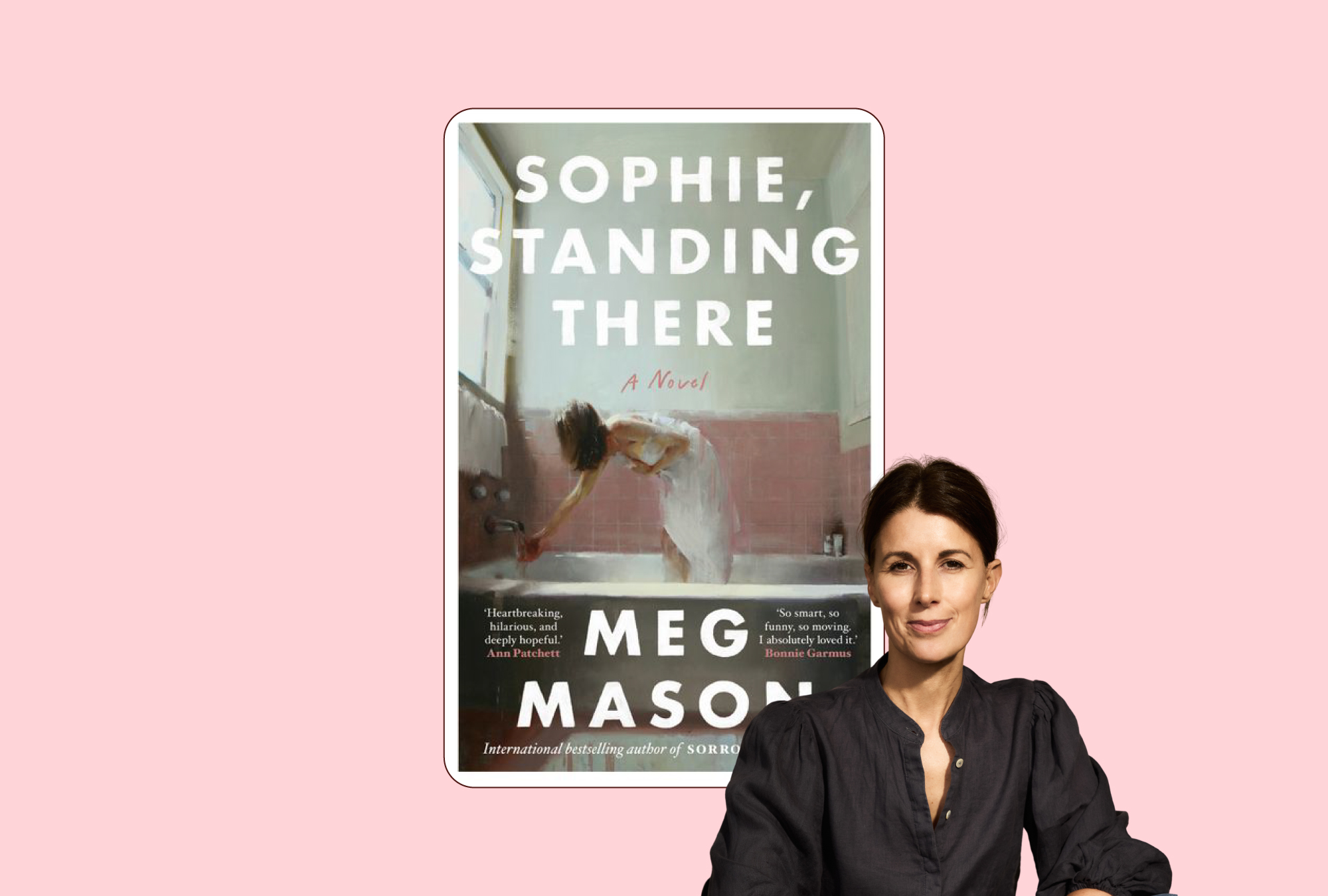
Meg Mason is a New Zealand-born, Sydney-based author and former journalist whose novels have found readers around the world. She is the author of You Be Mother and Sorrow and Bliss, the latter an international bestseller translated into more than 30 languages, winner of Fiction Book of the Year at the 2022 British Book Awards and shortlisted for the 2022 Women’s Prize for Fiction. It also happens to be one of my absolute favourite books
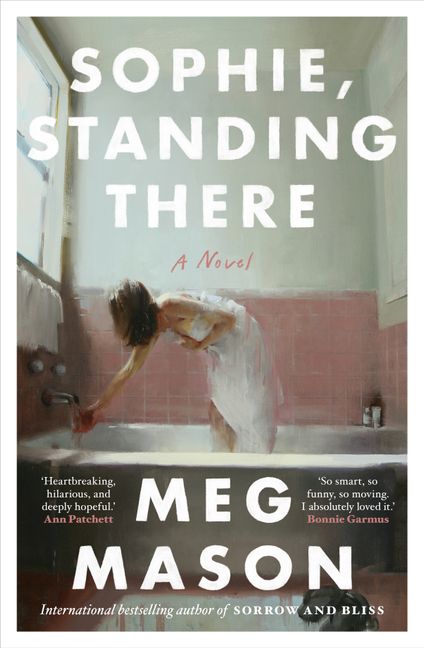
Her latest novel, Sophie, Standing There, takes us into the world of books, literary festivals and the complicated relationship between readers and writers. Sophie is a freelance sound technician working at a literary festival, navigating the breakdown of her marriage, a growing distance from her closest friend and an overwhelming sense of loneliness. A devoted reader who came to books later in life, she has developed a deeply personal connection to the work of her favourite author, Lilac Dunne. When Lilac is booked at the last minute to appear at the festival, Sophie is suddenly forced to confront the parasocial relationship she has built with an author who has no idea who she is.
At its heart, Sophie, Standing There is a novel about loneliness and belonging, but also about what books can become to us, what we ask of the people who write them, and the strange intimacy that can exist between a reader and an author who has never met them.
Q. It’s been six years since Sorrow and Bliss was published. The novel’s success wasn’t immediate, but it really took on a life of its own. Looking back, what do you remember most about that journey, and how has life changed in the years since?
The greatest change, the one I’m most thankful for, is I’m able to write fiction for a living now. Previously, it had to be out of hours, fitted around my full-time job as a journalist; I’d never actually written a book in daylight before, and in fact, I so struggled to get used to it that in the end the only way to write Sophie was by getting up at 4.30am, to write in the dark.
Q. Your new novel, Sophie, Standing There, feels like both a celebration and an examination of the literary world. Was the inspiration cumulative over many years of writing, or was it more directly shaped by the whirlwind after Sorrow and Bliss?
Before Sorrow and Bliss, I’d met maybe two authors in real life, only to interview them as a journalist so combined, I’d spent an hour in their presence; the rest of my exposure to their world was in the audience at literary festivals. To then, suddenly, age forty-three, find yourself in the wings of a literary festival, meeting every author you’ve ever loved, was entirely surreal. And while I loved every minute of it, I didn’t consider myself for even a second as belonging to that world. I was just lucky to get a glimpse into it, as a reader, like Sophie. I wasn’t consciously collecting it as material either – in fact, I swore I would never write a book about writers, writing, as it’s a notoriously hard thing to do without seeming self-fascinated or creating a world that reads as very exclusive, almost a bit clique. When I realised I did have to write about it, as a way of putting the experience away, I knew it would be from the perspective of someone who finds herself close to that world, but not in it; describing what it’s like to see your idols up close, in Sophie’s case, to love someone who doesn’t know you exist, doesn’t even see you as you serve them in the wings.
Q. The novel particularly explores the often parasocial relationship readers can have with their favourite author. What made you want to explore that dynamic?
I’m not sure if any author sits down to a novel with a list of themes they intend to explore. It’s more something you realise you’ve done afterwards, and only becomes someone tells you that’s what you’ve done. I’m so glad I didn’t have parasocial relationships as an ambition, as writing a novel where one of the two main characters is, for the first half, entirely imaginary would have felt, from a technical perspective, outside my gift.
Q. It was such a treat to see fictional versions of some very recognisable authors appear throughout the novel. How did those cameos come about, and what was Ann Patchett’s reaction when you asked if you could include her?
It seems to be my ‘process’ to start and abandon multiple novels over months and months, before I hit on the one that I’m meant to be writing. That was true with Sophie, who really did just walk into my mind one day, but I thought she was only a short story, that I’d spend a week on and never show anyone. That meant I could do write whatever I liked, just for my own amusement. But as it evolved into a novel, with an entirely made-up author at the centre, the only way to make her convincing was to surround her with real writers, ones we all know. Because I wasn’t just name-checking them but using them as actual characters – like, making George Saunders who is famously the nicest author in the world have a tantrum backstage about his Madonna mic – I knew I was going to have to seek their permission. And of course, I thought every single one of them would decline with thanks – there was absolutely nothing in it for them, it’s not as though Elizabeth Strout or David Sedaris or Bonnie Garmus needed my help to get their names out there – but all ten said yes, and I was so shocked and I will be forever.
Q. Lilac Dunne is magnetic, which makes Sophie’s fascination with her feel completely believable. Yet she also remains elusive. How much of her did you know yourself, and how much did you deliberately leave open to the reader?
The first half of this novel, I wrote in three weeks because I felt like I knew Sophie entirely from the opening sentence, but as soon as Lilac came in…it wasn’t as though I lost momentum but everything slowed because I had to think so hard about who she was, what her motivations were in choosing to spend time with a regular person when her habit and survival mechanism as a famous author is to remain aloof and avoid entangling herself, especially with a reader who claims to love her. When I just couldn’t figure it out, I decided that I wasn’t meant to – as though Lilac herself was refusing to reveal herself fully to me, exactly as she does with Sophie.
Q. Motherhood is a thread that runs through each of your novels, albeit in very different forms. What keeps drawing you back to exploring the complexity and diversity of motherhood?
Because, to me, it’s just an endless source. Recently, my mother sent me a photo of a story I’d written when I was five. In my infant handwriting, back-to-front letters, it read, ‘I loved you, said Megan, to Mum in the House,’ so it seems domestic fiction about mothers and daughter has been my main concern as a writer since I learned to write.
Q. What do you hope readers take away from Sophie, Standing There?
That loneliness is part of the human experience, not a reflection of who we are as individuals, or a consequence of our personality, and not something shameful, which is what it can feel like within that season. But like all seasons, it passes. Our people are out there, we just have to find them.
Q. What books have you recently read and loved?
It took me until this year to face down Middlemarch, having made so many previous attempts, always fading around page fifty. Listening to it (read by audio doyenne Juliette Stevenson) was the trick, this time, and feeling intimated by it for so long, it’s now one of my favourite novels of all time.
Q: And finally, what is the one book you always find yourself recommending to others?
At the moment, I cannot stop recommending The Palm House, by Gwendolyn Riley, and The Daffodil Days by Helen Bain, both recent novels.. For all time, it’s Brother of the More Famous Jack, by Barbara Trapido, and everything by Nancy Mitford.












Leave a Reply
You must be logged in to post a comment.